A Republic of Letters in Verse? Syriac Poems addressed to Individuals and Communities (9th to 13th Centuries)
EAST OF BYZANTIUM LECTURE
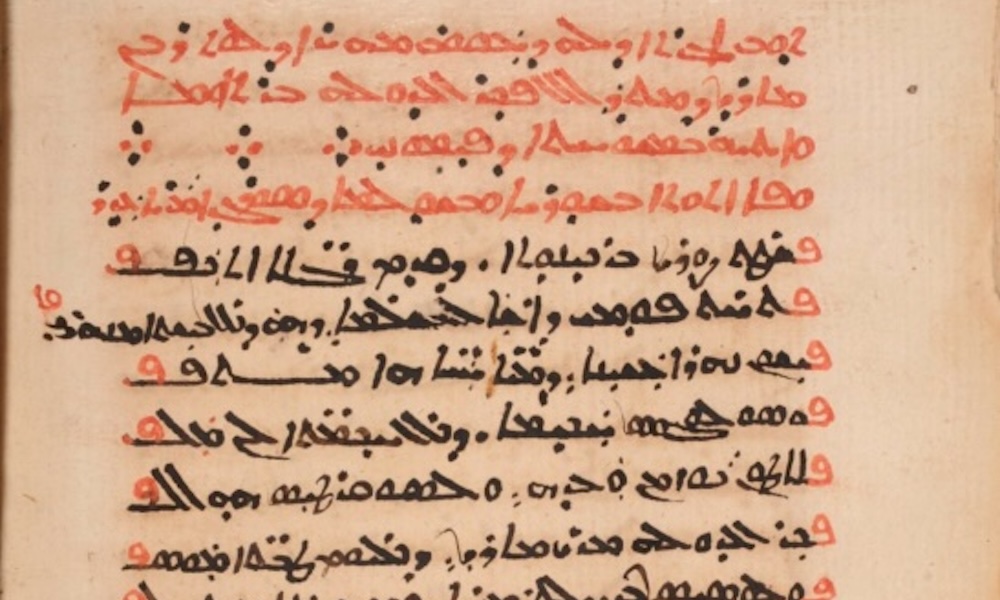
Poetry has long been recognised as a key genre in Syriac literature. The metrical homily is among the earliest sites of theological exposition in the Syriac tradition. My paper will trace developments in Syriac poetry between the 9th and 13th centuries to understand how the genre evolved into a form of scholarly exchange within and across the Syriac churches. I argue that Syriac poetry often functioned as an elite means of communication. In addition to being an important vehicle for ideas, the genre opens a window onto the intellectual and cultural milieus of its authors and other educated members of their communities.
The earliest Syriac poems about individuals tended to focus on Biblical characters and saintly figures. However, by the 9th century, we begin to see the emergence of praise poetry, particularly in the oeuvre of the West Syrian David bar Pawlos, whose panegyrics were addressed to people he knew. In later centuries, the genre continued to develop in new and interesting ways. East Syrian writers, such as John bar Zōʿbī (fl. early 13th century) and ʿAbdīshōʿ bar Brīkhā (d. 1318), tended to use verse in praise of their bishops and patriarchs—a convention often referred to as qullāsā d-parṣōpā (lit. ‘praise of the person’). Such poems often prefaced metrical treatises on learned subjects such as the computation of feast days, philosophy, and Christology. Poetry could also be deployed outside ecclesiastical contexts, as occurs in Jacob bar Shakkō’s (d. 1241) encomia to Fakhr al-Dawla and Tāj al-Dawla, two scions of the influential Ibn Tūmā family of late Abbasid Baghdad.
Syriac praise poetry takes a decidedly Islamicate turn in the later 13th century, due to contacts with a range of Arabic literary genres including madīḥ (panegyric), khamriyyāt (wine song), and ikhwāniyyāt (poems of brotherly love). This is best exemplified in Gregory Barhebraeus (d. 1286), who wrote several poems expressing love, admiration, and longing for various individuals. Barhebraeus also employed verse in scholarly exchanges with contemporaries, in what might be termed ‘epistolary poems.’
Salam Rassi is Lecturer of Islam and Christian-Muslim Relations at the School of Divinity, University of Edinburgh. His main area of research is Christian-Muslim interactions across theology, philosophy, and literature. Following the completion of his doctorate at the University of Oxford, he became a Mellon Foundation postdoctoral fellow at the American University of Beirut. He has also worked as a cataloguer of Syriac and Arabic manuscripts at the Hill Museum & Manuscript Library, Minnesota and was a British Academy Postdoctoral Fellow at Oxford. His first book, entitled Christian Thought in the Medieval Islamicate World, was published by Oxford University Press in early 2022.
This lecture will take place live on ZOOM, followed by a question and answer period.
 East of Byzantium