Sing to Him a New Song! Liturgical Hymns from Medieval Nubia
EAST OF BYZANTIUM LECTURE
Three Nubian kingdoms (Nobadia, Makuria, and Alwa), located in the Middle Nile Valley, became part of the Christian oikumene in the middle of the sixth century, receiving from Byzantium not only the faith, but also its setting, including Greek as the principal liturgical language and a set of texts used during liturgical celebrations. Singing was an integral and significant component of the Eastern Church ritual, and it is not surprising that hymns also gained popularity in Nubia.
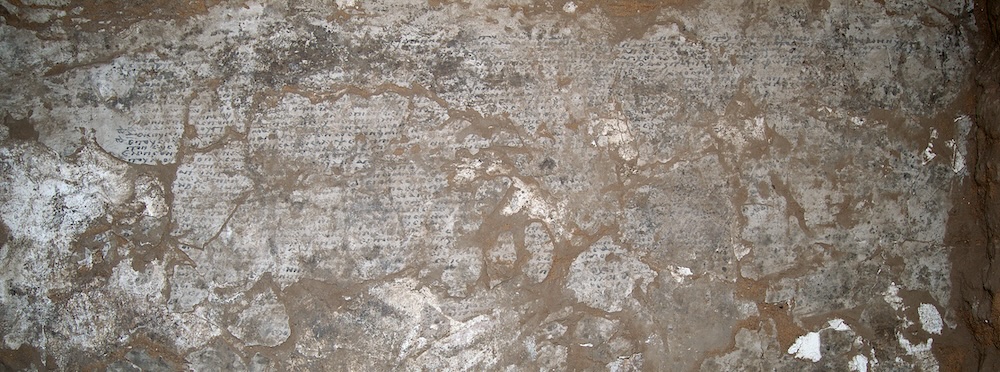
Texts at our disposal are mostly fragmentary, preserved in the form of parts of manuscript leaves, faded wooden tablets, or inscriptions written on the walls of cult buildings. Despite their fragmentary state, Nubian hymns exhibit a richness of forms and themes. There are troparia belonging to the oldest layer of Greek liturgical poetry and witnesses of the original Greek versions of the hymns by Severus of Antioch, known so far only through their Syriac translations. Longer compositions are also found, with the canon—a structured liturgical hymn composed of nine odes related to the nine biblical canticles—seemingly enjoying particular popularity.
These compositions span the spectrum of feast days as well as fixed celebrations, and also praise saints, especially Archangel Michael and Theotokos. Attestations of the usage of individual hymn verses in inscriptions left by visitors in churches indicate that singing to praise the Lord was widespread among the faithful. As a result, hymns are the largest and richest group of liturgica known from the area, shedding light on local liturgical practices. Additionally, the fact that some hymns are not preserved in their original form outside Nubia demonstrates that the material can contribute to unraveling the development of hymnography in Eastern Christianity at large.
Agata Deptuła is an archaeologist at the Polish Centre of Mediterranean Archaeology of the University of Warsaw, where she specializes in medieval Nubia and epigraphy. With over a decade of fieldwork experience in Sudan on sites such as Banganarti and Old Dongola, she focuses primarily on epigraphy and texts with liturgical significance. Her passion lies in deciphering inscriptions, particularly those that reveal the cultural and religious aspects of medieval Nubian societies. She is the author of the book Liturgical Poetry in Christian Nubia: The Evidence of the Wall Inscriptions in the Lower Church at Banganarti, which explores the hymnographic tradition and liturgical aspects of Nubian history.
This lecture will take place live on ZOOM, followed by a question and answer period.
 East of Byzantium