Centers and Peripheries in Orientalist and Imperialist Rhetoric on Medieval Armenian Art (1855–1953)
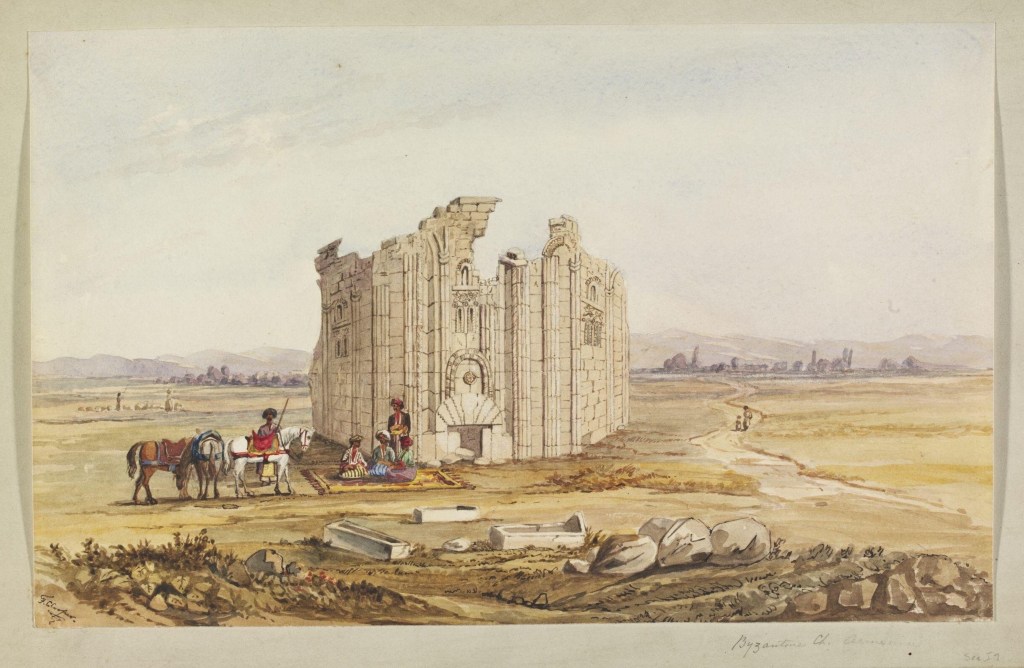
Despite titanic efforts by a group of scholars around the world, Armenian medieval art remains relatively marginal within the Euro-Atlantic canon. It is also often perceived as a sort of outlier of the Byzantine world. The purpose of this lecture is to show why such ideas—which are, incidentally, completely erroneous—still hold so much sway in popular opinion. In fact, as the main thesis of this presentation argues, they are the result of two centuries marked by “Western” Orientalism and Russian (and Soviet) imperialism. As will be demonstrated, since the mid-nineteenth century, art history has in fact served political interests in a very evident way. Examining the perception of medieval Armenian art also means critically reflecting on the history of the humanities in the face of modernity.
Ivan Foletti is full professor at Hradec Králové University and privatdozent at the University of Helsinki. He specializes in investigating the History of Art History and the art of Late Antiquity, the Early Middle Ages around the Mediterranean, in the Caucasus, and Russian art and emigration. He uses social and anthropological approaches to explore the impact of human migrations on visual cultures, and he is a specialist in the dialogue between art history and politics in Byzantine studies, especially in Russia and the Soviet Union. Professor Foletti is the head of CENT:RE. Centre for Visual Studies and Research Communication, director of the international journal Convivium (2014–) and of the Hans Belting Library. He taught as invited professor at the universities of Bologna, Fribourg, Helsinki, Lausanne, Naples, Padua, Poitiers, Prague and Venice. He is author of eight monographs, including From Byzantium to the holy Russia, Rome 2017 [2011], with Adrien Palladino, Byzantium or Democracy?, Rome 2020, and, Russian Imperialism and the Medieval Past, York 2024 [in Czech 2023, in Italian 2025].
This lecture will take place live on ZOOM, followed by a question and answer period.
REGISTRATION OPENS NOVEMBER 6, 2026

